The Intelligence of Symptoms
My best advice to you after 16 years in practice is this:
Stop chasing symptoms.
Whether you’re trying to understand your own body or you’re sitting across from someone else’s, this shift changes everything.
Most practitioners—even really good ones—are trained to solve problems.
Someone walks into your office carrying years’ worth of symptoms and experiences.
Maybe it’s:
- migraines
- constipation
- anxiety
- mold exposure
- childhood trauma
- abandonment
- adrenal fatigue
migraines
constipation
anxiety
mold exposure
childhood trauma
abandonment
adrenal fatigue
The natural instinct is to start pulling each one apart until you find the thing that’s causing all of it.
For most of us, that’s the path we’ve been taught to take.
But what if the goal wasn’t to identify the culprit…
but to understand the pattern?
What if the most important question we ask isn’t actually:
“What’s causing this?”
But instead:
“How has this person’s entire system organized itself around these experiences?”
One question sends you looking for a cause.
The other asks you to understand how the whole system learned to function.
Those questions don’t just produce different answers.
They lead to entirely different interventions.
Here’s why.
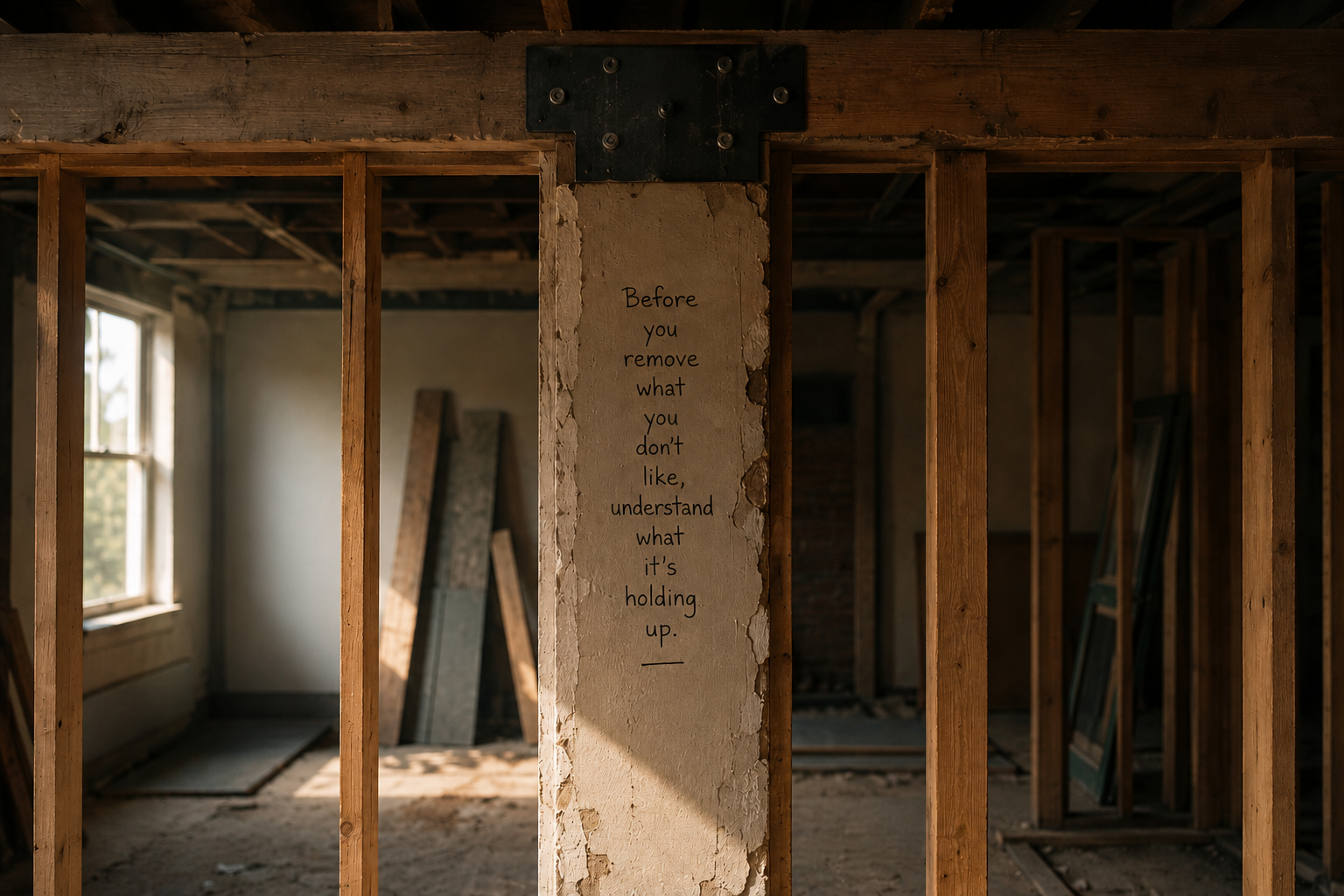
Think about a load-bearing wall in a home.
Just because you don’t like where the wall is—or the way it interrupts the flow of the room—doesn’t mean you can simply knock it down.
Before that wall comes out, someone has to determine what it’s holding up.
Support beams have to be put in place.
The weight has to be redistributed.
Otherwise…
you don’t just remove a wall.
You compromise the entire structure.
I think we’ve underestimated the intelligence of symptoms.
There are consequences to symptom alleviation that we don’t often consider.
When we go after symptoms without first understanding the role they’ve been playing inside the body’s ecosystem, we’re essentially removing a load-bearing wall without asking what it’s been supporting.
When we remove an adaptation before understanding why it exists, the body often finds another way to solve the same problem.
Sometimes the symptom isn’t the problem.
Sometimes it’s the thing preventing a much bigger collapse.
The moment you begin viewing symptoms as adaptations, the questions change.
You stop asking:
What does this mean?
and start asking:
What job is this doing?
Every pattern has a job.
Every adaptation is contributing something.
The question is whether we’ve taken the time to understand what that contribution is.
Asking the right question from the very beginning also helps you distinguish between the content someone brings into the room and the architecture that’s organizing their experience.
Another idea that’s completely changed how I listen to people is the difference between content and architecture.
Content is what someone tells you.
It’s the story they’ve built to explain why they’re experiencing what they’re experiencing.
Most content is a combination of truth, protection, and what someone simply can’t see yet.
Architecture is what’s organizing the story.
It’s what becomes visible when you stop looking at symptoms individually and start looking at the whole person.
It’s what you can begin to recognize when you view someone through multiple lenses—the parts they can articulate, and the parts that remain invisible to them.
Someone says,
“I’m depressed.”
That’s the content.
The architecture could be:
- unresolved grief
- hypothyroidism
- inherited family patterns
- profound loneliness
- living completely out of alignment
- a nervous system that’s been conserving energy for years
unresolved grief
hypothyroidism
inherited family patterns
profound loneliness
living completely out of alignment
a nervous system that’s been conserving energy for years
Same symptom.
Completely different architecture.
This is why protocols so often fall short.
Protocols treat the content instead of understanding the structure that’s holding everything together.
As people become more complex—and as the way symptoms present becomes more complex—practitioners are going to be required to think from a more sophisticated place.
This is where thinking like an architect comes in.
It is in both your best interest and your patient’s to draw one blueprint instead of making, organizing, and trying to keep track of seven separate files.
The reality is people aren’t a collection of disconnected symptoms.
They’re living systems.
Living systems organize themselves for survival.
And once you understand how the structure has organized itself…
you’ll know which walls can come down…
and which ones need support before they ever do.
The body has always been communicating.
The question isn’t whether it’s speaking.
It’s whether we’re asking questions that allow us to understand what it’s trying to say.
If you’ve been looking for a place where physiology, herbal medicine, astrology, and systems thinking can exist in the same conversation…
Welcome.
That’s exactly what you’ll find here.
I share a new essay each week exploring the patterns beneath our health, our habits, and the way we move through the world. If that sounds like your kind of rabbit hole, I’d love for you to subscribe.
